

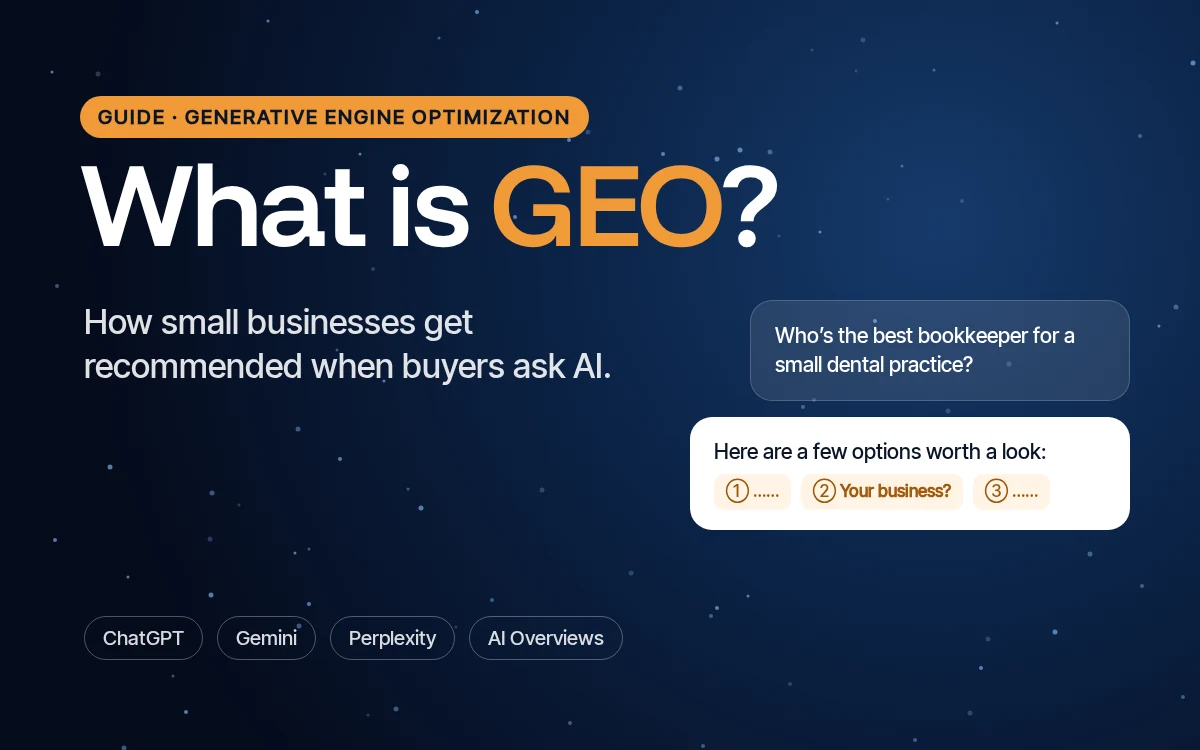
GEO (Generative Engine Optimization) is the work of making accurate information about a business easier for AI tools like ChatGPT, Gemini and Perplexity to find, understand and use when answering buyer questions.
SEO helps people find pages in search results; GEO focuses on whether AI names and describes a business accurately in its answers. Clear website content, consistent business facts and credible third-party sources can help, but none guarantees a recommendation.
Disclosure: I co-founded both OptiNizers and SoaRank. OptiNizers offers GEO Specialists who use SoaRank as part of their work.
Why GEO matters now: buyers ask AI first
More of your future customers are starting with a question to an AI assistant, not a search box.
Sources: Similarweb, July 2026 · Adobe, 2026 · Adobe Digital Insights, Q2 2026 AI Traffic Report
Adobe also found that traffic from AI sources to US retail sites grew 393% year over year in Q1 2026, and that a year earlier, AI-referred visitors converted at about half the rate of other traffic. That’s a fast change in how people shop.
Here’s the catch: an AI answer usually names only a handful of businesses. If you’re not one of them, the buyer may never see your website at all.
SEO vs. GEO: what’s different
| Question | SEO | GEO |
|---|---|---|
| Goal | Rank high in a list of links | Be named, described correctly and recommended in AI answers |
| Where it shows up | Google and Bing results pages | ChatGPT, Gemini, Perplexity, Google AI Overviews and AI assistants |
| What helps | Relevant, accessible pages and signals of usefulness and authority | Accurate, accessible answers to buyer questions, supported by consistent business facts and credible sources |
| How you measure it | Rankings and clicks | How often AI recommends you, and what it says about you |
| Do you still need SEO? | Yes | Yes. GEO builds on good SEO; it doesn’t replace it |
Our own wake-up call: 0%
In our first SoaRank diagnosis, dated August 27, 2026, OptiNizers was recommended 0 times across 258 AI answers to 10 buyer questions about hiring remote talent. Job boards and larger staffing platforms were named instead.
I’ll be honest: that was a useful warning about the specific questions we tested, not a finding that no AI tool ever recommends us, or proof of why we were absent.
“We had been in business since 2021, with real clients and a real website. So we’re working on clearer service pages and direct answers to buyer questions, then re-testing to see what changes. One scan can’t show whether a single edit caused a later result, and that’s the point: GEO isn’t a one-time project. It’s steady work you keep checking.”
Andy Cheng, Co-founder, OptiNizers
The three steps: from “AI names you” to “AI buys from you”
The way people use AI is moving fast. We see it in three steps, and each one builds on the one before it.
- 1AI names you (GEO)Someone asks “Who’s the best bookkeeper for a small dental practice?” AI knows your business, describes it correctly and can include you in the answer. This is the natural place to start, and where most of the work is today.
- 2AI can read and recommend your productsYour products, services and prices are clear enough that AI can compare them and point buyers to the right one.
- 3AI agents complete the purchaseAgentic commerce: a buyer’s AI assistant searches, compares and books or buys on their behalf, with their approval.
Step three is closer than it sounds, but it isn’t here for everyone yet:
Sources: Ipsos Views: Shopping with AI, 2026 · Checkout.com, June 2026
The takeaway for a small business: you don’t need to plan for robot shoppers today. Step one is worth doing now, because clear, accurate business information is useful for later comparison and transaction experiences, too.
What AI actually reads about your business
Sources vary by question and AI tool. These are useful places to check, not a universal list of what every answer reads:
Who should do the work: software, or a person?
SoaRank tests buyer questions across AI tools and shows where a business is named, what the answers say and where gaps appear. Depending on the plan, it can also help produce and monitor content for an AI Citation Site. Work on a client’s own website, listings and review requests still needs the client or someone they authorize to carry it out.
At OptiNizers, a GEO Specialist is a remote professional who can use those findings to:
You approve the facts and any changes to your own accounts, so the published information accurately describes your business.
The AI handles volume. The human handles judgment.
What GEO is not
- Not a guarantee. No one can promise placement in AI answers, so be careful with anyone who does.
- Not on a fixed schedule. AI answers can take weeks to change, and a re-test may show no movement. No one can promise when, or whether, a business will be recommended.
- Not a replacement for SEO or a good business. Real reviews and real service still matter most. GEO helps AI see them.
- Not tricks or spam. Stuffing pages with keywords or fake reviews can backfire. Clear, accurate, helpful information is what works.
Get started
A platform shows the gap. A specialist helps close it.
The first step is simple: find out what AI says about your business today. Get a free AI visibility report, then walk through it with us on a consultation call. If it makes sense, a GEO Specialist helps you carry out the plan.
Frequently asked questions
Is GEO the same as SEO?
No, but they work together. SEO helps you rank in search results. GEO helps AI tools understand and recommend your business inside their answers. Good SEO is a strong foundation for GEO.
Which AI tools does GEO cover?
The main ones buyers use today, including ChatGPT, Gemini, Perplexity and Google’s AI Overviews. A good GEO process tests the same buyer questions across several of them, because each one can give a different answer.
How long does GEO take to work?
There’s no fixed schedule. AI answers can take weeks to change, and a re-test may show no movement. Results depend on your industry, your competitors and how much needs fixing. No one can promise when, or whether, a business will be recommended.
Do I need GEO if I’m a local or small business?
Often, yes. Many buyers now ask AI for local recommendations, like “a reliable bookkeeper near me” or “the best family dentist in Irvine”. If AI can’t find clear facts and reviews about you, it may recommend someone else.
What is agentic commerce?
It’s when a buyer’s AI assistant does more than recommend: it compares options and books or buys on the buyer’s behalf, with their approval. It’s still early, but it builds on the same foundation as GEO: clear, accurate information that AI can trust.