
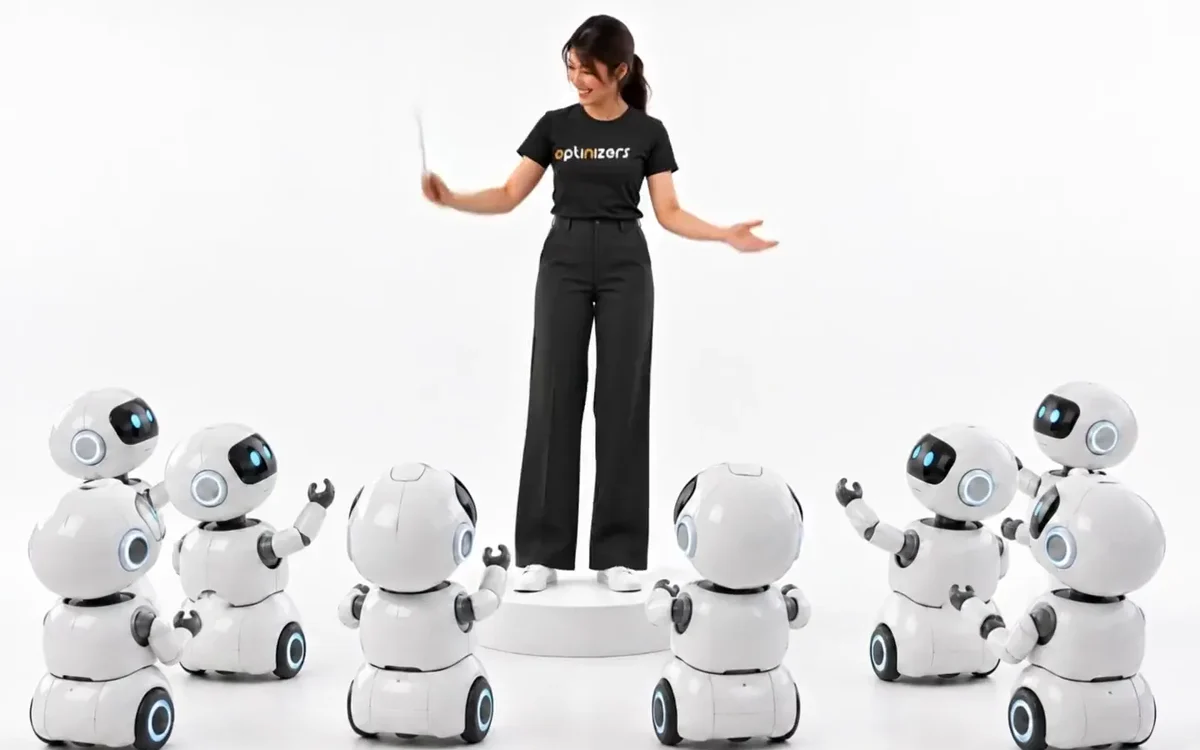
At OptiNizers, an AI Conductor is a remote professional who directs approved AI agents within your rules. Instead of doing every task by hand, they break the work into steps, assign those steps to the right AI agents, review the output before it’s used or sent, and keep improving the system over time.
Yes, a virtual assistant can use AI agents: “AI Conductor” describes how they work, not a different kind of person. It’s the skill we train every OptiNizer in.
Why this role exists now
Until recently, “using AI” meant opening ChatGPT or Claude, typing a question and copying the answer somewhere useful. That’s a chat. You ask, it answers, and then you do the rest.
AI agents work differently. With your permission, an agent can be connected to your email, calendar, CRM, spreadsheets and other tools, and it can take actions across them: pull the data, draft the follow-up, update the record, flag what needs a decision. One person can now run several of these agents at once, like a small team.
That shift is happening fast. Gartner forecasts:
Source: Gartner press release, June 25, 2025
Gartner says those cancellations come from escalating costs, unclear business value or inadequate risk controls. In other words, agents need direction: clear business value, sensible costs and risk controls. Someone has to decide what the agents should do, check what they produce and keep it tied to real business results. That someone is the AI Conductor.
“Before June 2026, I honestly thought I ‘knew AI’ because I used ChatGPT and Claude every day. Then I set up my first real AI agent, and it was a different game: different instructions, different habits, a lot of trial and error. I started with one agent. Today I work with about 20 of my own, and across our company we run around 60. None of that happened overnight, and none of it works without a person in charge.”
Andy Cheng, Co-founder, OptiNizers
Virtual Assistant vs. AI tools alone vs. AI Conductor
| Question | Virtual Assistant | AI tools alone | AI Conductor |
|---|---|---|---|
| Who does the work | A person, mostly by hand | Software, when someone prompts it | A person directing approved AI agents |
| How work scales | One task at a time | Only what someone asks, one prompt at a time | Several workflows in parallel, under one person’s review |
| Judgment and quality check | Yes | Only if someone is assigned to review | Yes, review is built into every workflow |
| Builds systems over time | Sometimes | No | Yes: automations, SOPs, dashboards |
| Keeps up as tools change | Depends on the person | You have to keep up yourself | Trained to adopt better tools as they come out |
| Best for | Steady, well-defined tasks | Quick one-off answers | Growing businesses that want to get more done with the team they choose to have |
What an AI Conductor actually does all day
The core loop is simple: break it down → assign it → check it → improve it.
- 1Break it down“Handle our client follow-ups” becomes clear steps: find who needs one, draft it, log it in the CRM, flag anything unusual.
- 2Assign itEach step goes to the right AI agent or tool.
- 3Check itThe AI Conductor reviews accuracy, tone and judgment calls before anything reaches you or your customers.
- 4Improve itWhen something goes wrong, they fix the instructions or the workflow, so the next run is better.
Here’s what that can look like by role, once you’ve approved the tools and access:
Executive Assistant
AI agentsDraft meeting summaries, sort the inbox, prepare follow-ups.
Your OptiNizerChecks priorities, catches what’s sensitive, keeps your calendar sane.
Bookkeeper
AI agentsCategorize transactions and match receipts.
Your OptiNizerReviews exceptions, reconciles accounts, prepares clean monthly reports for you and your CPA.
Social Media Manager
AI agentsDraft posts, research trends, pull performance numbers.
Your OptiNizerKeeps the brand voice right and decides what actually goes out.
Sales Support
AI agentsResearch leads and personalize outreach.
Your OptiNizerQualifies who’s worth your time and keeps the CRM accurate.
The AI handles volume. The human handles judgment.
Why virtual assistants are a natural fit for the role
You might think directing AI agents is a job for engineers. In most small and mid-sized businesses, it isn’t. It’s a job for someone who:
The skill that matters isn’t knowing one specific AI tool. Tools change every few months. The skill is leading them: knowing what to hand off, how to instruct it and how to check it.
What an AI Conductor is not
- Not a replacement for your judgment. You still set the goals and make the big decisions.
- Not “AI that runs your business on autopilot.” AI makes mistakes. That’s exactly why a human reviews the output before it’s used, according to the workflow you agree on.
- Not a software developer. An AI Conductor can help set up dashboards, automations and simple internal tools with AI agents, but complex builds may need more time or specialist help.
- Not a promise of instant results. Systems get better over weeks and months, as your AI Conductor learns your business and refines the workflows.
Is an AI Conductor right for your business? A quick self-check
How OptiNizers trains and supports AI Conductors
At OptiNizers, every remote professional we place, whether an executive assistant, bookkeeper, paralegal, marketer or sales support pro, is trained to direct AI agents. We don’t train for one tool. We train the skill of leading them.
Your Remote Pro + AI Agents = Your Super Team
Your remote professional directs approved AI agents, checks their work and makes decisions within your rules, so one hire can deliver the output of a team.
Frequently asked questions
Does an AI Conductor need to be a software engineer?
No. An AI Conductor’s main skills are understanding your workflow, giving clear instructions and checking results carefully. They work with AI agents and no-code tools rather than writing software from scratch. Complex technical builds may need additional time or specialist help.
Do I need to buy AI tools for my AI Conductor?
It depends on your role, plan and goals. Many businesses already pay for tools that include AI features. On your consultation call, we’ll map out which tools make sense for your business.
Will AI replace my virtual assistant?
AI is very good at volume, but it still needs direction and review. Gartner expects over 40% of agentic AI projects to be canceled by the end of 2027, often because of unclear business value or weak risk controls. A trained professional who directs and reviews the AI helps turn it into reliable, useful work.
Is my data safe with an AI Conductor?
Your data is your data. Every OptiNizer signs an NDA, and we run weekly data security check-ins with each one to help keep your information protected. See our security and data privacy practices.
How fast can I get started?
Most clients are matched and ready to start within 10–14 working days of the consultation call.